

PHP vs IOP in Illinois: Which Level of Mental Health Care Do You Need?
The World Health Organization (WHO) says that over 1 billion people worldwide face mental health challenges. Of those, most don’t receive a proper diagnosis or treatment ever. For instance, in the US, only 52% of people with mental health conditions got treatment in 2024, as per SAMHSA.
Besides the lack of practical treatment options and their costs, other factors that prevent people from seeking timely help include the confusion around it. Someone dealing with depressive thoughts or anxiety episodes wouldn’t want to do the mental maths of which treatment model will work for them.
Hence, Forrest Behavioral Health makes this decision easier, so you can get straight to treatment. Today we’ll settle the PHP vs IOP debate and explain when to opt for which model; keep reading and choose the best for your mental health.
When to Go For a Partial Hospitalization Program for Mental Health
Partial hospitalization (PHP), also called day treatment, is a slightly relaxed version of an inpatient stay. You visit the treatment facility 5-7 days a week for 4-8-hour sessions and return home at night. These regular visits ensure you and the healthcare provider work closely on the triggers, and there is no restriction to make you feel caged.
Since PHP requires sufficient time and effort commitment, the recovery results reflect that, and you can get a hold of your health troubles pretty fast. That said, here are the situations where PHP in Illinois is the best decision:
High Treatment Intensity Required
When a person needs structured clinical support most of the day but still doesn’t want to stay at the hospital, day treatment works best for them. For example, if your symptoms are severe enough to disrupt your daily functioning but you’re stable enough to return home in the evening, PHP will do wonders.
Since this model offers several hours of therapy and medication management, it bridges the gap between inpatient rehab and standard outpatient treatment. Also, you receive daily psychiatric monitoring, so intense anxiety, depression, or mood instability can be managed well.
Recurring Triggers and an Unsupportive Environment
Some people live or work in settings that constantly trigger their mental health challenges. For example, a household with conflict or emotional neglect will not help your situation. Such an environment can also reverse outpatient treatment progress; hence, partial hospitalization helps address this situation.
PHP removes you from a triggering or negative environment for most of the day and replaces it with structured therapeutic contact.
Moreover, regular clinical check-ins help identify how the environment might affect your recovery, so you can adjust treatment accordingly.
Situation Progressively Getting Worse
If your mental health symptoms are worsening despite treatment, it simply means the current program isn’t working well. But luckily, PHP can intervene and fix the situation before it gets out of hand. Put simply, if a person is feeling more isolated or the intensity of their episodes increases, they need a solid schedule to face the challenges, and PHP does just that.
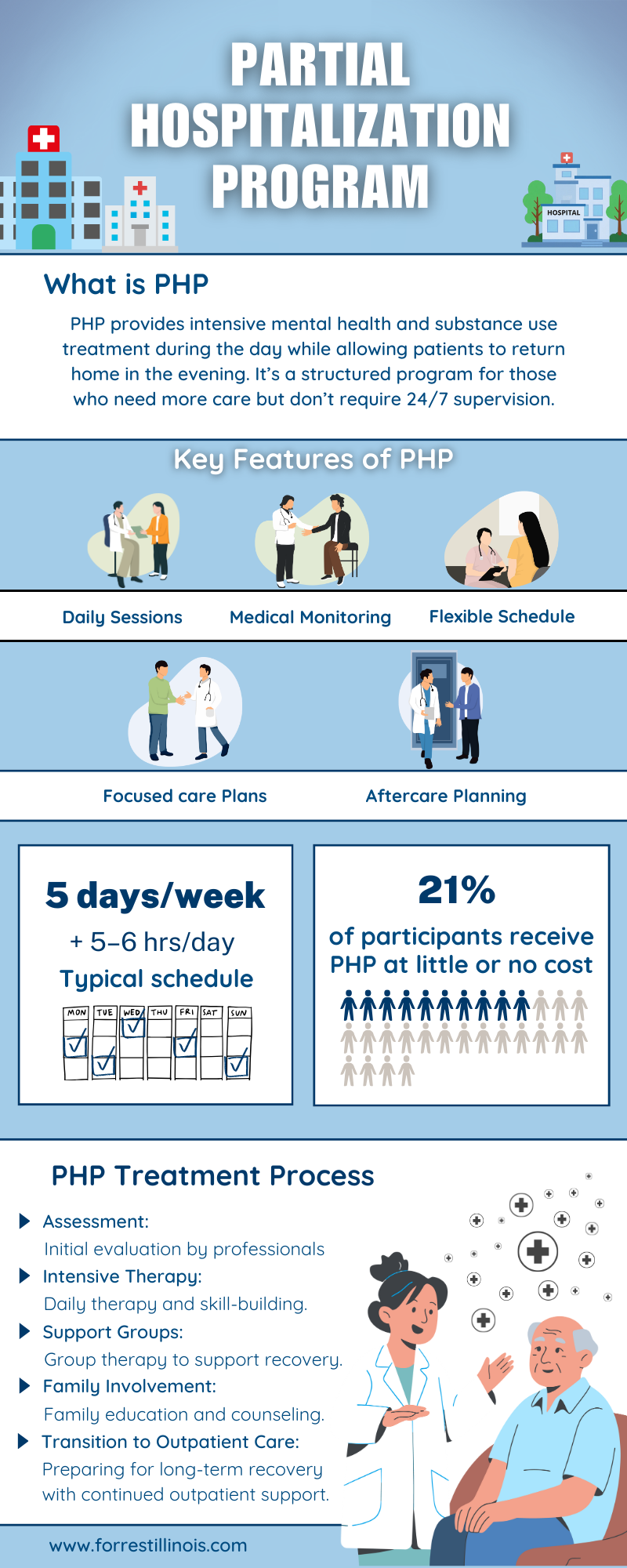
This model allows clinicians to intervene early with a higher level of structure and gives you daily support to stabilize the condition while you still live at home.
When to Choose Intensive Outpatient Treatment for Mental Health?
Every person’s mental health challenges are different and so are their priorities. For example, one person might prefer daily treatment center visits, while another might want a more relaxed schedule. That said, you visit the treatment facility for 3-5 days a week during an intensive outpatient program (IOP), and the sessions mostly run in 3-hour stretches.
Here are the situations where mental health experts recommend IOP in Illinois:
Relatively Moderate Condition
When someone’s mental health-related symptoms are present and disruptive but don’t require all-day supervision, IOP works best. You might be generally stable and able to manage between sessions. This model offers a few hours of group and individual therapy several days a week, focused on building and reinforcing coping skills.
Placing someone with a moderate condition into a more intensive program can be unnecessary and difficult to sustain. Therefore, IOP offers a solid structure to support meaningful progress as you actively work on your challenges.
Work and Home Responsibilities
Another reason experts prefer IOP in Illinois for mental health is the presence of life responsibilities. When you can’t take a break from work, school, or family-related tasks to recover, IOP is a practical approach. It can be scheduled around your busy schedule and help you balance both important aspects without giving up on either.
Eventually, you can receive consistent clinical support without having to withdraw from your responsibilities. Also know that IOP’s goal is not to minimize the seriousness of treatment; instead, it makes the whole thing more sustainable.
Step-Down Care
IOP often enters your recovery journey after you have completed an inpatient treatment or partial hospitalization. Since moving from a highly structured program back to full independence increases the risk of relapse, IOP offers a middle ground. It allows you to maintain regular clinical contact via several weekly sessions.
Also, this structure gradually solidifies your sense of responsibility and independence, which ultimately works towards your recovery goals. Needless to say, IOP is a deliberate midpoint between intensive care and full independence, rather than an abrupt return to normal life.
Never Compromise On Your Mental Health
We get physical ailments and injuries treated fast, but often delay mental health treatment. Maybe it’s because of the stigma attached to weak mental health or the fact that fixing it takes patience and consistency.
But whatever the case may be, you must not put your mental health on the back burner—it impacts all aspects of your life, so never take it lightly.
If you need help deciding when to start treatment and which model will help your situation the most, Forrest Behavioral Health is a call away. Reach us at 312-449-2491 whenever you feel ready!