

Mental Health IOP in Chicago: An Alternative to Inpatient Treatment
Accepting that you need mental health support is a heavy journey where you often minimize your challenges. That internal battle might make you think your struggle isn’t as big and that you can survive without treatment. But life isn’t only about surviving, right? Life should be lived and experienced, which is only possible if you’re in control of your emotions and actions.
Therefore, mental health treatments exist; they get you out of the dark phase and bring clarity to your life. However, another confusing aspect of this treatment is its intensity; many assume it’ll be sterile and hospital-like, which delays their decision. Luckily, models like mental health IOP in Chicago support your recovery and allow you to keep a fully functional life outside of it.
If you’re concerned that treatment will feel like jail, keep reading to know how IOP is a practical alternative.
How Does Mental Health IOP in Chicago Work?
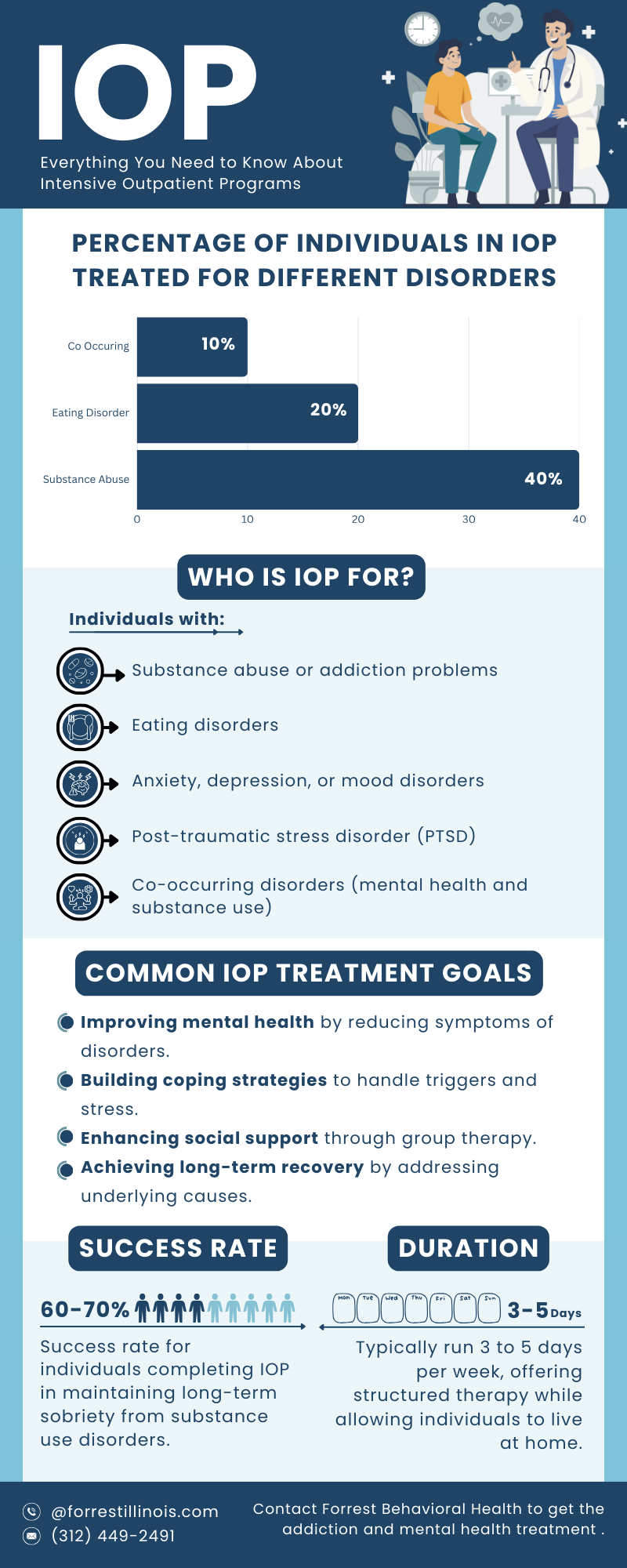
Mental health IOP in Chicago is the sweet spot between a restrictive inpatient rehab and weekly therapy that doesn’t offer enough support when you’re struggling. An intensive outpatient program runs 3-5 days a week, with each session lasting 2-4 hours. Like any other mental health treatment model, these sessions can be scheduled in mornings, afternoons, or evenings.
At Forrest Behavioral Health, we have noticed that people prefer evening IOP slots so they can work or attend school. And as their progress continues, some programs reduce the number of weekly sessions to ease the transition to less frequent care.
How Can Mental Health IOP in Chicago Substitute for Inpatient Treatment?
While ‘the more, the merrier’ stands true for mental health treatment, you don’t always have to follow a strict schedule to recover. An intensive outpatient treatment is regulated enough to ensure your struggles are recognized and worked over. At the same time, it doesn’t lock you in a rubber room where you feel further isolated.
Here is how this treatment model is changing lives:
Shorter Time Commitment
Inpatient treatment overwhelms many because it asks for months away from your life. Since you have to stay at a treatment facility for this specific treatment, such a gap isn’t realistic for everyone. When you’re concerned about job security, childcare, or school, committing to an inpatient program will feel impossible.
Therefore, mental health IOP in Chicago offers a middle ground: its sessions run for 2-4 hours, multiple days a week, so the treatment fits around your schedule rather than taking it over completely.
It provides enough clinical contact to address the underlying issue without cutting you away from life. If someone has a stable home environment and no immediate safety risk, this lighter time commitment will encourage them to start treatment. However, know that there is a tradeoff: less supervision means more personal responsibility.
Lower Cost Than Inpatient Programs
Enrolling in an inpatient treatment program means you bear multiple costs, including room, board, and staff. Those costs add up fast, and not every insurance plan covers them fully. Luckily, IOP cuts a lot of that overhead, since its sessions are held during set hours rather than around the clock, so the cost structure is leaner.
Also, some insurance plans cover IOP at a higher rate than residential programs, which narrows your out-of-pocket expenses. However, don’t think IOP is a discounted version of treatment; instead, it’s planned to accommodate more people.
Fewer Waitlists
Getting into an inpatient facility means more decision and wait fatigue. In many facilities, beds are limited, and you face waitlists before treatment starts. Needless to say, that delay can harm someone who’s ready to commit to treatment, but IOP doesn’t have the same bottleneck.
Intensive outpatient treatment doesn’t rely on physical bed space or full-time staffing per patient, so more people can be admitted. In busy cities like Chicago, faster treatment processing is a huge benefit because demand for mental health services can otherwise outpace supply.
Job Stability
Not everyone can take weeks off from work for treatment because many jobs don’t offer such a leave, and even if they do, the patient takes a financial hit. Therefore, mental health IOP in Chicago has sessions scheduled around work hours so you can hold your job while still getting consistent care.
And beyond ensuring your job is safe, this model benefits your well-being. Put simply, employment and the sense of living your normal life give you structure and make you feel relevant. When you don’t have to step away from important things, you can focus better on the treatment. But this surely requires more discipline, so be honest if you have the bandwidth to manage recovery and daily obligations.
Avoids Re-entry Adjustment Period
Inpatient treatment creates a bubble where stressors, triggers, and responsibilities don’t exist. And while that distance can help early recovery, it creates a problem later: re-entry. When you step back into the same environment after discharge, the relapse risk spikes because the skills you learned inside the facility haven’t been tested against real conditions.
IOP sidesteps this problem because you never leave the daily environment and there’s no jarring transition to manage. Plus, you apply coping strategies in real-world situations from day one, rather than practicing them in isolation. Even though this difference makes progress slower to measure in some cases, it also means your recovery is suited to the life you’re returning to.
Slow and Steady Wins the Race
One might think going all in is the only way to improve your mental health, but sometimes gradual and consistent efforts can outpace that. Mental health IOP in Chicago provides a stable environment where evidence-based therapies are used to address your struggles. At Forrest Behavioral Health, we make sure you never feel pressured and take recovery at your preferred pace. So don’t let any problem get bigger than it is; call us at 312-449-2491 and let’s put this challenge behind us.