

IOP for Anxiety in Illinois: Intensive Treatment Without Hospitalization
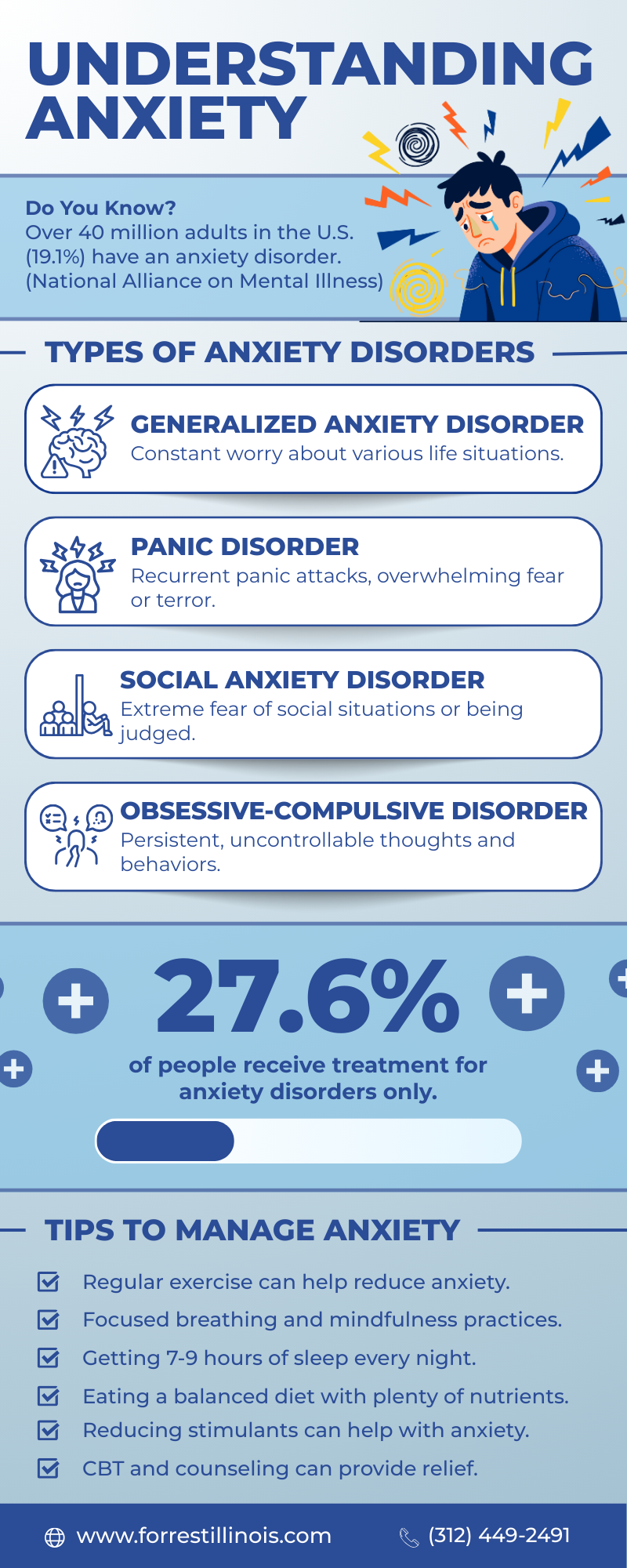
Have you ever found yourself getting through your entire day with a smile while your mind is quietly overwhelmed by worry and panic? Your body feels like it’s in fight-or-flight mode, while everything around you seems to keep functioning, but you’re not really feeling okay. If weekly sessions just aren’t cutting it anymore, an IOP for Anxiety in Illinois could give you the extra structure and care you’re looking for, without hitting pause on your everyday life.
An Intensive Outpatient Program (IOP) sits right in that gap between weekly therapy and a hospital stay. Using approaches like Cognitive Behavioural Therapy (CBT) and Dialectical Behavior Therapy (DBT), you pick up real tools for handling anxiety and put them to work in your day as it happens.
At Forrest Behavioural Health, care starts with the belief that no two people share the same story. We pair therapies with a track record of steady, dependable support, so you can learn what actually calms you down, find your footing day-to-day, and get well on your own terms.
Below, we’ll walk through what intensive outpatient care for anxiety in Illinois really looks like, who it may be right for, what a normal day in mental health treatment involves, and how you can get serious help without leaving home.
What Is an IOP for Anxiety, and How Does It Actually Work?
An Intensive Outpatient Program (IOP) is a step up from seeing a therapist once a week; you can still sleep in your own bed at night. In Illinois, enrolling in an IOP for anxiety offers focused, evidence-based treatment three to five days a week, with sessions typically lasting three to four hours.
Unlike a hospital stay, an intensive outpatient program lets you head home each evening, maintain family responsibilities, and continue working or attending school, depending on the program’s schedule.
Key Components of Intensive Outpatient Programs
- Group Therapy:
Sit with others dealing with the same anxiety you are, so you feel less alone and get better at handling people.
- Individual Therapy:
You’ll meet one-on-one with a therapist who actually listens to what sets your anxiety off, then shapes a plan around the things that trouble you most.
- Medication Management:
Sit down with a psychiatric provider to review your medication, tweak the dose, or keep an eye on how it’s working.
- Family Support & Psychoeducation:
Involve family members to foster a supportive home environment and assist them in understanding the mechanics of anxiety.
How Does an IOP Provide Intensive Anxiety Treatment Without Hospitalisation?
If anxiety is getting in the way of your day but you don’t need round-the-clock hospital care, an IOP for Anxiety in Illinois can offer a middle ground. Rather than living at a facility, you show up for therapy several days a week and go home afterwards.
So you get more help than a weekly therapy hour, but you don’t have to drop your job, your classes, your family, or the rest of your week to do it. And whatever you pick up in treatment, you get to try out that same night at home.
Feature | Weekly Therapy | IOP for Anxiety | Inpatient Care |
Treatment | 1–2 sessions/week | Multiple sessions/week | 24/7 care |
Where You Stay | Home | Home—no hospitalization | Treatment facility |
Main Focus | Ongoing support | Intensive anxiety treatment | Crisis stabilization |
Daily Life | Mostly unchanged | Maintained with structure | Temporarily paused |
The key difference is that an IOP provides intensive treatment without requiring a hospital stay. It’s built for people who need more than a weekly session but are safe enough to sleep at home.
What Therapies Are Used in an IOP for Anxiety?
What makes intensive outpatient treatment work is that it leans on methods researchers have actually tested. Instead of just talking about anxiety, programs across Illinois drill the behavior itself, retraining how your brain reads a threat.
Cognitive Behavioral Therapy (CBT)
CBT goes after the thought spirals and worst-case guesses your mind keeps running, then teaches you to build steadier ones in their place.
Exposure and Response Prevention (ERP)
ERP matters most for severe anxiety, panic disorder, and OCD. It walks you, slowly, toward the thoughts or situations you dread, without letting you duck out or lean on a safety habit. Your nervous system eventually catches on: the danger it feared can be handled.
Dialectical Behavior Therapy (DBT) Skills
DBT hands you real moves for riding out distress, steadying your emotions, and staying present, so you don’t lose your footing when panic hits hard.
In an IOP for Anxiety in Illinois, these therapies don’t stop at conversation. You practice what you learn during the week, in the situations that actually set you off, and you sleep at home every night.
Is an IOP Covered by Insurance in Illinois?
Before anything else, most people want to know what this will cost. In Illinois, commercial insurance, Medicaid, and Medicare all cover intensive outpatient care, because mental health treatment counts as an essential health benefit.
Working Through Your Insurance
- Checking your network: The treatment center usually calls your insurer directly or sets up a single-case agreement. Most work with Blue Cross Blue Shield of Illinois, Aetna, Cigna, and UnitedHealthcare.
- Proving you need it: Your insurer decides whether an IOP is the right level of care by looking at how bad your symptoms are, how much they’re disrupting your life, and what you’ve already tried.
- What comes out of pocket: Co-pays, deductibles, and coinsurance depend on your plan. The admissions team should sit down with you before you start and give you a straight number.
An IOP costs far less than residential treatment, and you still get the full clinical program.
Final Words!
An IOP for Anxiety in Illinois gives you more than a weekly therapy hour, and you still sleep at home. Between regular sessions, therapies like CBT, DBT, and ERP, a plan built around you, and steady support, you learn what calms your own anxiety and use it where life actually happens. The point is real care, serious care, without a single night in the hospital.
At Forrest Behavioral Health, we’ve seen how differently anxiety shows up from one person to the next. So we start with you: what your symptoms are doing, what actually settles them, and how you get your confidence back for the ordinary parts of a day. You do that work through outpatient care, without stepping away from your home or your week.
Not sure if an IOP is the right fit? Call Forrest Behavioral Health and ask. We’ll walk you through our anxiety treatment options in Illinois, and you can decide from there whether it feels like the right move.
Read Next: Beyond the Buzz: Specialized Clinical Support for Anxiety in the Chicago Area