

Dual Diagnosis Treatment in Chicago: Mental Health & Addiction Care
Hardly anyone comes in and says they’re dealing with two problems at once. What you hear is, “The drinking got bad. The panic attacks are back. I can’t sleep unless I take something. Then three weeks pass, and the whole picture becomes clear: the drinking had been covering up anxiety that was there long before the first drink. It usually goes that way. The substance isn’t the problem. It’s what somebody found to make the problem bearable.
As time goes by, the two problems can become so tied together that dealing with one while ignoring the other does not really solve the whole problem. That gap is exactly what dual diagnosis treatment in Chicago is built to close. Instead of treating addiction with one provider and depression with another who never speaks, an integrated care team treats both at the same time, because that is how the two actually behave in a person’s everyday life.
It matters because fixing one side leaves the other sitting right where it was. SAMHSA reported that roughly 21.2 million American adults have a mental illness and addiction in 2024.
At Forrest Behavioral Health, we treat the person in front of us, not a list of symptoms on a chart. Our team works with people across Illinois who are dealing with addiction and mental health condition at the same time. We build the plan around you, and we use treatment that works. That’s the whole idea.
Below, we’ll walk through how dual diagnosis treatment actually works, what an integrated care team in Chicago does day to day, and why treating both sides at once is what makes it hold.
What Is Dual Diagnosis, and Why Do Mental Health and Addiction Go Hand in Hand?
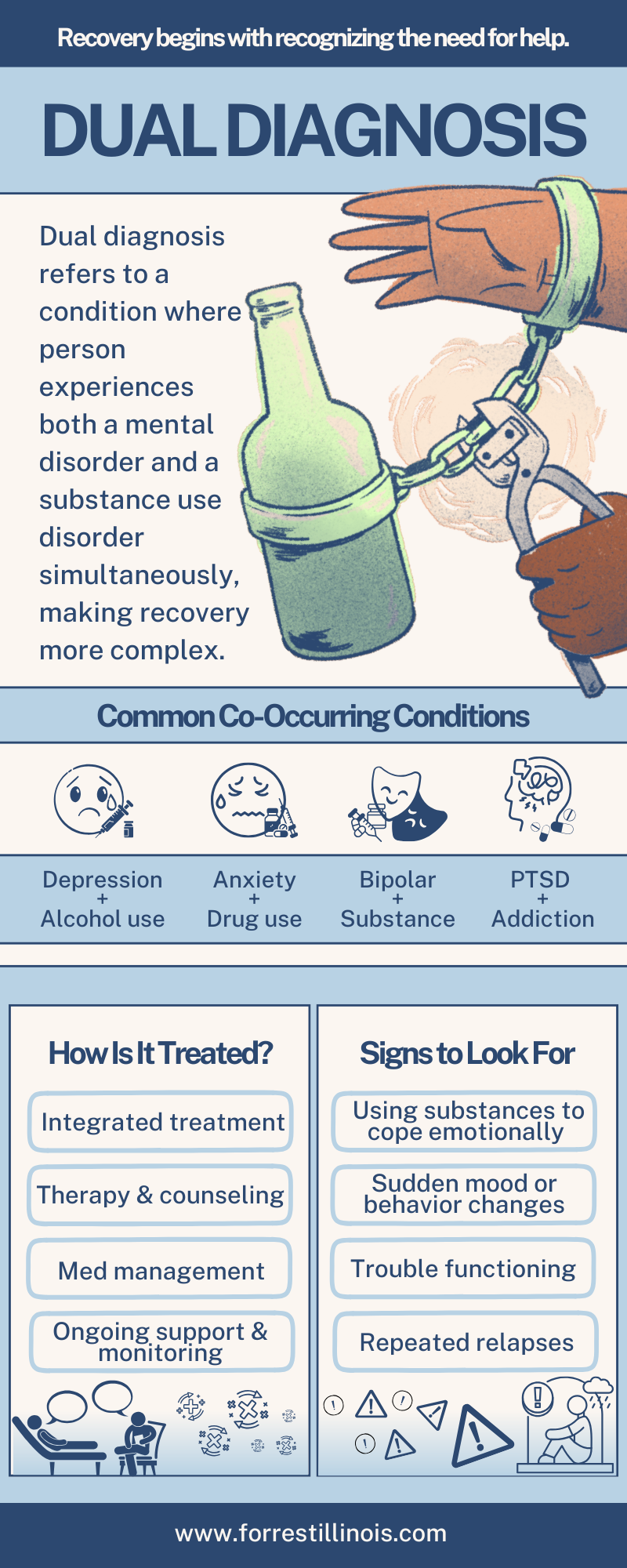
You’ll hear two terms for this: dual diagnosis and co-occurring disorders. Both mean the same thing: somebody is dealing with a mental health condition and addiction problem at once. That could be depression, anxiety, PTSD, or bipolar disorder alongside the drinking. National research suggests that co-occurring conditions affect nearly half of people with an addiction.
These two problems rarely show up separately, and there’s a reason. Drinking quiets the thoughts that won’t stop. It gets you through a room full of strangers. It dulls something you’d rather not think about.
That can work for a while, until alcohol starts affecting how your brain handles mood. Then the depression gets worse, and you end up drinking more. That’s the loop, and treating one side doesn’t break it.
Common Conditions Treated Side-by-Side
- Depression and Alcohol Use: Alcohol gives you a short lift, then takes more back. It’s a depressant, so the mood it improves is the same one it flattens.
- PTSD and Opioid Use: After trauma, the body never fully stands down. Opioids are the quietest thing most people find.
- Anxiety and Sedatives: When the pressure won’t let up, people reach for whatever works fast. A few months later, they can’t stop.
How Does Integrated Dual Diagnosis Treatment in Chicago Actually Work in Practice?
Twenty years ago, the answer at a treatment center was: sober up first, then we’ll deal with the anxiety. Mental health clinics said the same thing in reverse. People got bounced between them.
Integrated care means one team, one building. Your psychiatrist, counselor, family therapist, and doctor talk every day and work off the same plan. Nobody has to guess what the others are doing. Therapy that’s proven to work, plus medication that’s properly monitored.
Core Modalities Used in Integrated Treatment
- Cognitive Behavioral Therapy (CBT): Helps you catch the thoughts that can lead you back to drinking and gives you something else to do with them.
- Dialectical Behavior Therapy (DBT): Teaches you how to sit with something painful long enough for it to pass, instead of reaching for a drink the moment it starts.
- Trauma-Informed Care (EMDR): Works through the memories underneath, at a pace that feels safe and manageable.
- Psychiatric Medication Management: Medication that isn’t habit-forming, used to steady your mood, take the edge off cravings, and quiet what’s underneath.
What Therapies Are Used for Dual Diagnosis Treatment in Chicago for Mental Health and Addiction?
Most people want to know what happens after they walk in. Therapy takes up a lot of it. What kind you get depends on your diagnosis, what you’ve been using, and where you want to end up.
Cognitive Behavioral Therapy (CBT)
CBT is about spotting how a thought turns into a feeling and how that feeling turns into a drink. If anxiety is what sets you off, you work on the thoughts that show up first, before the drinking starts.
Trauma-informed care
If something happened to you, treatment accounts for that. Nobody is going to make you talk about it before you’re ready. The first stretch is about feeling safe enough that talking becomes possible at all.
Group and Family Therapy
You don’t have to do this by yourself. Group therapy gives you a place to try things out in front of people who already get it. Family sessions give the people around you a clearer picture of what’s going on and what actually helps.
That’s not just our opinion. SAMHSA has found that families make a measurable difference in recovery on both the mental health side and addiction care.
Medication Management
Some people need medication, and some don’t. If you do, there’s one set of prescriptions for the mental health condition and a separate set, FDA-approved, for alcohol and opioid dependence. SAMHSA’s position is that medication and counselling belong together. A prescription on its own leaves too much of the work undone.
Final Words!
If you’ve tackled the drinking and then watched the anxiety come back, or the reverse, you already know why treating one at a time doesn’t hold. Both together are the only version that works. Therapy, medication where it’s needed, real attention to what happened to you, and somebody still checking in six months from now. That’s what gets underneath the cycle instead of managing the surface of it.
At Forrest Behavioral Health, we build the plan around the person sitting in front of us, not the diagnosis on the chart. Our team works with people across Illinois and Chicago who are dealing with both a mental health condition and addiction care. You don’t have to sort this out by yourself.
Call Forrest Behavioral Health today. We’ll talk through what treatment would look like for you and answer whatever you need answered before you decide anything.
Read Next: IOP for Anxiety in Illinois: Intensive Treatment Without Hospitalization