
IOP for Bipolar Disorder in Illinois: What Treatment Looks Like
It’s 2 a.m., and your brother’s acting like he’s figured out the whole thing. He barely slept all week, has three company ideas, a new career strategy, and enough energy to chat till dawn. Then a few weeks hit and boom. The same guy can barely text you back, can’t drag himself out of bed, and when you ask what’s wrong, he just can’t explain it. It’s all just too much and pointless.
If you know what it’s like watching someone bounce between these crazy ups and crushing downs that bipolar disorder brings, you understand the toll. It wears everyone out. The person going through it. The people who care about them. All of it.
So about 4.4% of U.S. adults experience bipolar disorder at some point; that’s what the National Institute of Mental Health tells us. For people living in Illinois, an intensive outpatient program for bipolar disorder offers an effective middle ground. You actually get the help and structure you need to get better, but you’re not stuck in some hospital away from everything. You keep your life. You keep working. You just get the support you actually need.
Forrest Behavioral Health doesn’t just provide treatment for you. They have doctors, therapists, counselors, and psychiatrists who work together to determine what you actually need. Their programs in Illinois are built that way too, completely customized to your needs. They work on grounding you, teaching you practical coping skills, and helping make recovery sustainable so it doesn’t just fall apart later.
We’re going to break down exactly what an IOP for bipolar disorder in Illinois actually involves, what treatment looks like, and why this kind of care can help you recover.
What Actually Happens in an IOP Day?
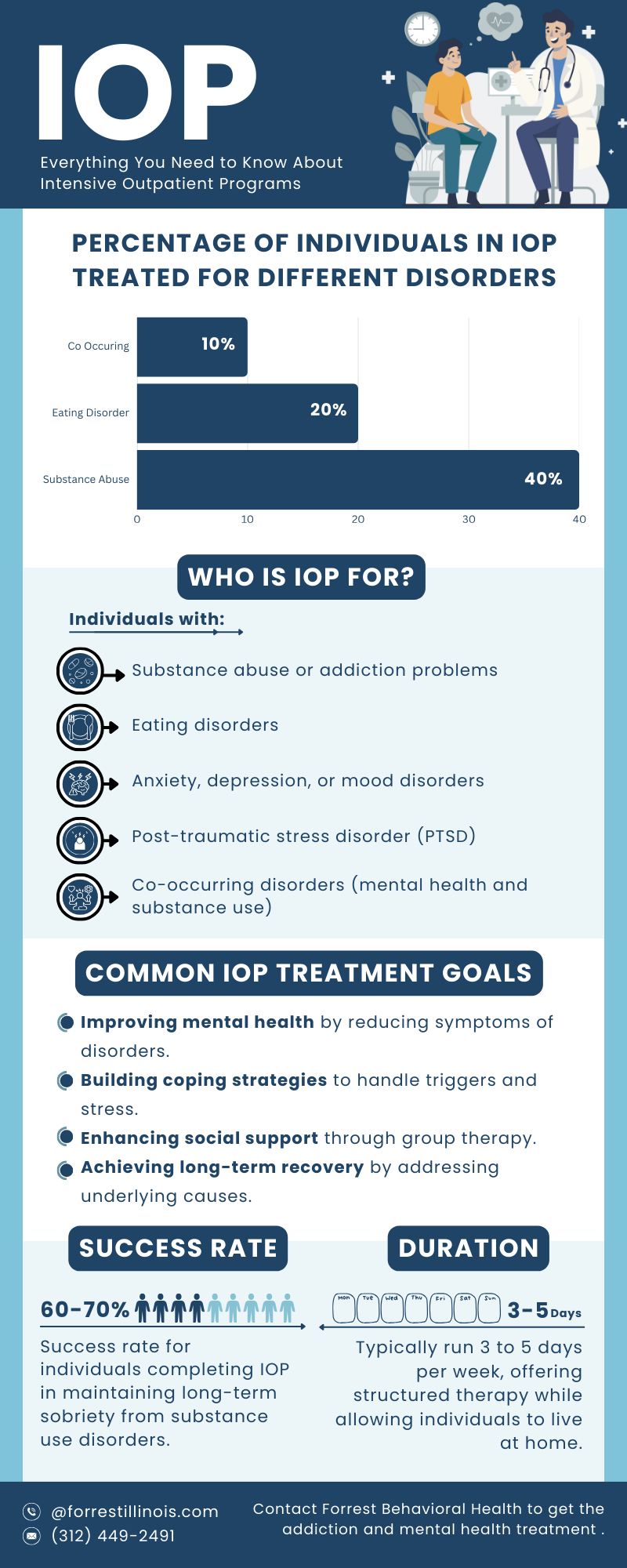
An IOP is three hours a day, three to five days a week, for six to twelve weeks total. You sleep in your own bed. You probably keep working. But while you’re there, stabilising your mood is the primary focus.
Block | What happens | Why it matters for people with bipolar disorder |
Check-in (20 min) | Mood rating, sleep hours, med adherence | Sleep loss is a significant predictor of a manic switch |
Group Therapy (90 min) | Skills work and emotional processing | You hear people describe experiences that may feel similar to your own. |
Individual & Family Session | Weekly to twice weekly | Where more personal concerns can be discussed |
Psychiarty | Monitoring lithium levels, adjusting lamotrigine doses, and managing side effects | |
Skills blocks (45 mins) | Behavioral rehearsal planning | Turn insights into practical daily habits |
Understanding what an IOP for bipolar disorder looks like in Illinois starts with understanding its daily schedule. It involves consistently practicing the same core strategies: tracking your mood, logging sleep, and participating in group therapy until you begin recognizing patterns before they become more noticeable to others.
What Specific Therapies Are Used for Bipolar Disorder in an IOP?
Bipolar disorder requires a treatment approach tailored to mood symptoms, medication needs, and daily routines such as sleep.
Key Evidence-Based Modalities
- Cognitive Behavioral Therapy (CBT): It can help you snap out of the negative thought loops when you’re down and chill out impulsive thoughts during periods of elevated mood or increased energy.
- Dialectical Behavior Therapy (DBT): It teaches you to handle distress, manage emotions, and stay mindful, giving you real tools to ride out emotional waves without impulsive choices.
- Interpersonal and Social Rhythm Therapy (IPSRT): IPSRT is specifically for bipolar disorder, keeping your schedule, sleep, and social life stable because disrupted routines can contribute to mood instability.
- Family-Focused Therapy: Getting family involved in sessions builds solid home support, gets better communication happening, and teaches them to recognize the early warning signals when mania or depression is starting to kick in.
- Prodrome mapping: You identify and document your personal early warning signs. Examples might include opening shopping tabs at midnight, talking faster, or skipping your usual activities for several days. Then you write what you’ll do when you see them and who you’ll tell.
What matters when considering an IOP for bipolar disorder in Illinois is how these therapy tools work together to give you solid, lasting strategies for real stability and balance.
How Does IOP Help Someone Manage Bipolar Symptoms Long-Term?
You know that person who just got through a brutal depression. They’re feeling better but not quite back to normal. Their sleep schedule is disrupted. Exercise went out the window. Work feels like too much. And they’re constantly worried the next episode is coming.
That’s where an IOP for bipolar disorder in Illinois can help. It stops being about just making it through the crisis and starts being about building real skills to stay healthy and avoid it happening again.
Learning to Recognise Warning Signs
Treatment helps you recognize patterns that show mood changes coming. These include major shifts in sleep, activity, thinking, energy, or how you’re acting.
You learn to track your mood and identify how stress, sleep, medication, and relationships may affect your symptoms.
NIMH specifically recommends maintaining consistent routines for eating, sleeping, and physical activity and keeping mood journals to help catch mood shifts early.
Building Practical Coping Skills
Therapy isn’t just about talking about what went wrong the previous week. A solid IOP actually teaches you how to handle stuff when real problems pop up. Depending on your treatment plan, you may learn skills such as:
- Stopping racing or negative thoughts
- Spotting what triggers emotions
- Communicating with others about your experiences
- Handling stress
- Improving your sleep routine
- Planning to prevent relapse
- Improving medication adherence
- Knowing what to do when red flags start.
STEP-BD, a study funded by NIMH, showed that structured psychotherapy combined with medication helped people with bipolar depression
Final Words!
Bipolar treatment isn’t just about managing the next manic or depressive episode. It’s learning what your patterns look like, spotting the signs before they get bad, keeping routines locked in, and having backup support so things don’t fall apart. An IOP for Bipolar Disorder in Illinois gets this. It provides real structure and support without forcing you to abandon home or your normal day-to-day living.
Forrest Behavioral Health builds treatment around you, not the other way. The team takes a caring approach to help you develop practical coping skills, find stability, and create recovery that actually sticks around.
If bipolar symptoms are messing with you or someone you love, don’t sit around waiting for the next crisis to hit before reaching out. Contact Forrest Behavioral Health today. They’ll show you what treatment options exist and help you figure out whether an IOP is actually the right step forward.
Read Next: Dual Diagnosis Treatment in Chicago: Mental Health & Addiction Care